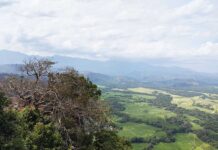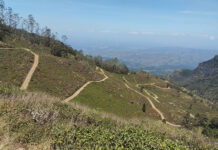

Pidurutalagala Mountain and the Forest Reserve are situated almost next to the heart of Nuwara Eliya Town.
In 1897, a path was made to climb Pidurutalagala Mountain. The four-mile track to the top could have been made by walking for two and a half hours, or could have been made on horseback.
The British preferred to call this mountain “Pedro” because pronouncing it as “Pidurutalagala” was a difficult task for them.
The meaning of the word Pidurutalagala can be likened to “Straw-laden rock “.
Mountain of Pidurutalagala
A forest reserve surrounds the mountain of Pidurutalagala. The forest suffered damage five years ago in a forest fire, resulting in the loss of approximately 3 acres of woodland. However, the damage is being repaired now, thanks to the assistance of both nature and human intervention.
The area of the mountain and forest reserve has been designated an ultra-high security zone due to the summit being used to house the communications array of the Sri Lankan Government and the country’s armed forces.
Unlike most mountain summits, which are rocky, Pidurutalagala Mountain in Sri Lanka had a cap of pale green vegetation on its somewhat flat summit as per eyewitness accounts of the 1940s. During the summer months, the vegetation tended to dry to a pale yellow, giving it a straw-like appearance, hence the name ‘Straw Laden Rock’ or ‘Pidurutalagala’ in Sinhala.
During the early 20th century, the mountain still had only a single human-made path to the summit. The only other trails were from the elephants that frequented the hill. The rest of the mountain was all untouched vegetation.
The artificial path to the top had been marked at regular intervals throughout the ascent with stone posts, indicating heights such as 7,500 feet and 8,000 feet. Earlier in the 1940s, on the mountain summit there had been a “Toposcope” or a type of a Map which had a circle of pointed arrows that showed the directions of certain important places with distances of ‘line of sight’ from Pidurutalagala or “Mt. Pedro”, such as Colombo, Adam’s Peak, Dondra Head, Horton’s Plains, etc.
One could clearly see and identify faraway places such as Yala, Hambantota, Bintenna, Namunukula, Horabora Wewa, and Bay of Trincomalee, which were marked on the Toposcope.
Is Pidurutalagala Mountain open to the Public?
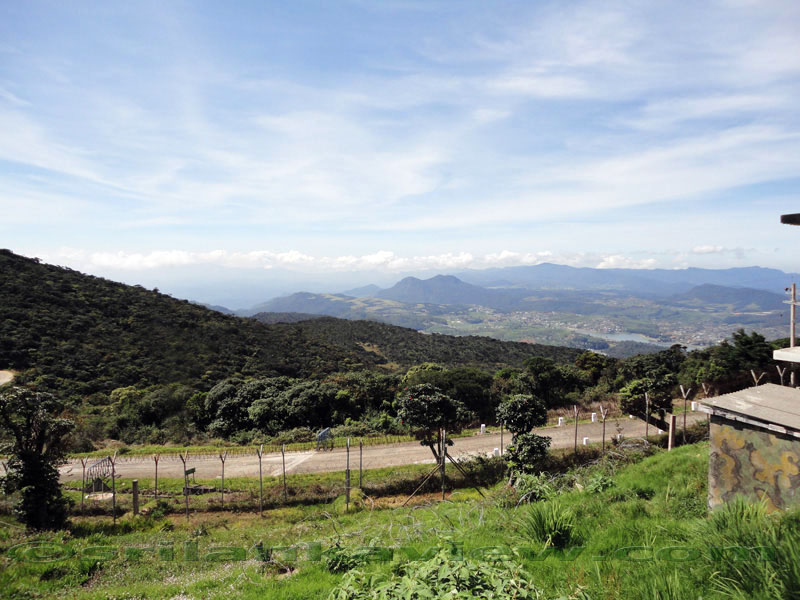
Pidurutalagala Mountain in Sri Lanka is closed to the Public for most of the year. However, during specific periods of time, passes of admission can be obtained for a drive to the top. Trekking is strictly not allowed. Once the vehicle enters the limits of the Security Point at the base, it must be driven without stopping or anyone disembarking from the car until it reaches the Upper-Security Point at the mountain’s summit.
What Visiting Pidurutalagala Actually Feels Like
Most travelers imagine Pidurutalagala as a dramatic mountain climb or viewpoint. In reality, visiting Pidurutalagala is closer to entering a restricted high-altitude forest corridor than a classic sightseeing attraction.
Once you pass the initial security checkpoint, the drive becomes noticeably quiet. The temperature drops slightly, mobile signals fluctuate, and the surrounding forest feels denser and less manicured than the tea estates below. There are no cafés, no viewpoints to stop at, and no photo spots along the road — this is intentional.
The experience is not about ticking off a viewpoint. It is about understanding that you are passing through a protected ecological and strategic zone that functions very differently from public parks or hiking trails in Sri Lanka.
Travelers expecting a “climb” often leave disappointed. Travelers who arrive curious about why this place is restricted usually leave with a deeper respect for it.
Why Pidurutalagala Is Closed — Beyond “Security Reasons”
Most articles simply say Pidurutalagala is closed due to “military use,” but that explanation is incomplete.
Pidurutalagala’s summit plays a role in:
- National communications infrastructure
- Weather and signal monitoring
- Strategic line-of-sight coverage across the Central Highlands
Because of this, unrestricted public access would create:
- environmental pressure on fragile montane grasslands
- logistical risks to essential infrastructure
- safety concerns unrelated to wildlife
This is why even approved visitors are not allowed to stop, walk, or explore freely. The restrictions are not symbolic — they are operational.
Understanding this context helps visitors avoid frustration and unrealistic expectations.
Forest Reserve Reality: What You Will NOT See
Despite being part of a forest reserve, Pidurutalagala is not a wildlife viewing destination.
Visitors should know:
- Animals remain deep inside restricted forest areas
- There are no guided nature walks
- No birdwatching points or interpretive signs
- No public trails or picnic areas
The ecological value of the reserve lies in what is left undisturbed, not what is presented to visitors.
This makes Pidurutalagala fundamentally different from places like Horton Plains National Park, which are designed for controlled public access.
Who Pidurutalagala Is For — and Who Should Skip It
This place is worth visiting if you:
- Are curious about Sri Lanka’s geography and highland ecosystems
- Enjoy understanding restricted or lesser-known places
- Want context rather than classic sightseeing
- Are already staying in Nuwara Eliya and have time
You may want to skip it if you:
- Expect hiking, viewpoints, or photography stops
- Want close-up nature or wildlife experiences
- Prefer clearly curated tourist attractions
- Are short on time
This honesty improves visitor satisfaction — and trust in your content.
Local Tip Most Visitors Miss
If you want to feel Pidurutalagala without visiting the restricted summit, spend time in the early morning around Nuwara Eliya town instead.
On clear days, the mountain subtly dominates the skyline, especially just after sunrise when cloud layers sit below its peak. Locals often recognize weather changes by watching how clouds gather around Pidurutalagala — something no signboard explains.
Why Visit Pidurutalagala
Pidurutalagala is not only the highest peak of Sri Lanka, but also one of its most impressive and significant landmarks. Here are some of the reasons why you should visit Pidurutalagala.
Height
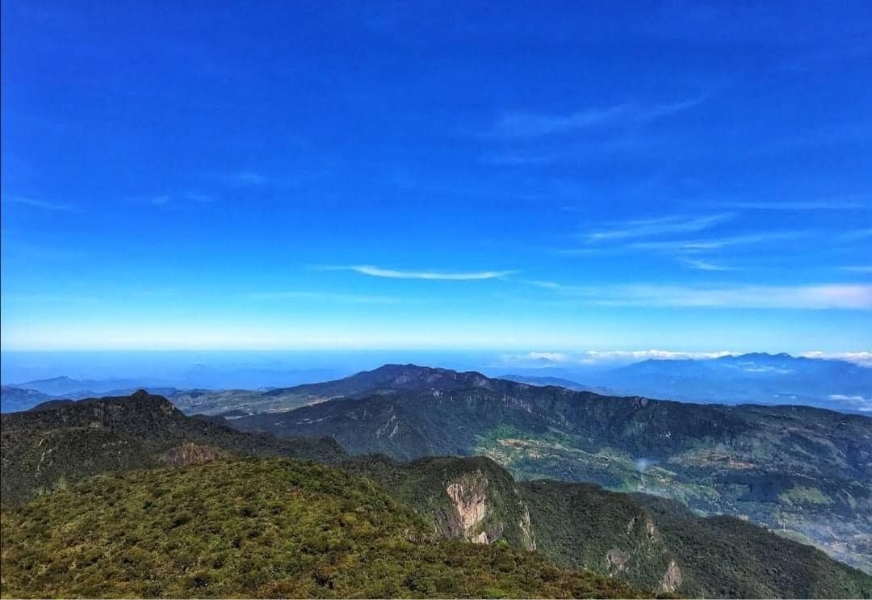
Pidurutalagala stands at an elevation of 2,524 meters (8,281 feet) above sea level, making it the highest point of the island. From the summit, you can enjoy a panoramic view of the surrounding landscape, including the hills, valleys, forests, lakes, and tea plantations of Nuwara Eliya and beyond. On exceptionally clear days, distant landmarks of the Central Highlands may be visible, though views vary depending on weather conditions and access limitations.
Scenery
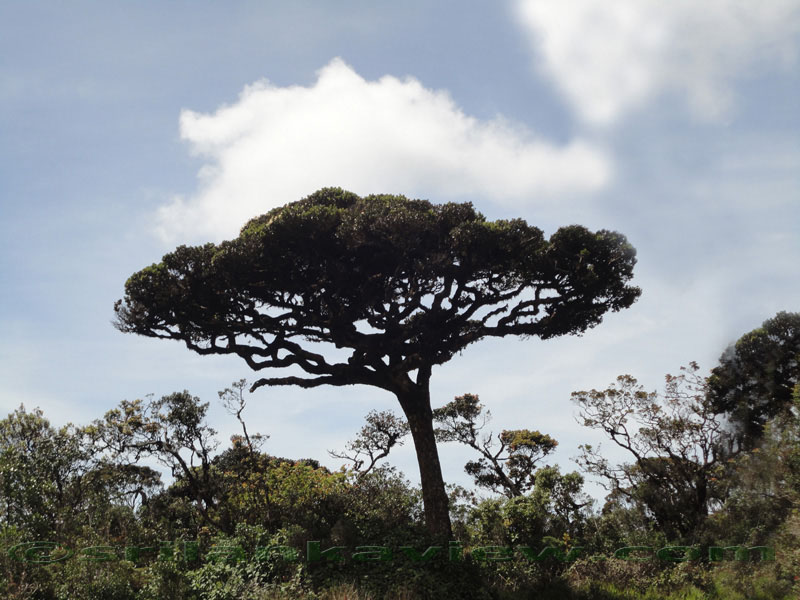
Pidurutalagala is a stunning sight to behold, especially during sunrise and sunset. The peak is covered with lush green vegetation, including pine trees, grasslands, and a variety of flowers. The mountain is also home to a diverse array of wildlife, including monkeys, deer, leopards, and a variety of birds. Public hiking is not permitted on Pidurutalagala, and wildlife encounters are extremely rare due to access restrictions and the protected nature of the area.
Biodiversity
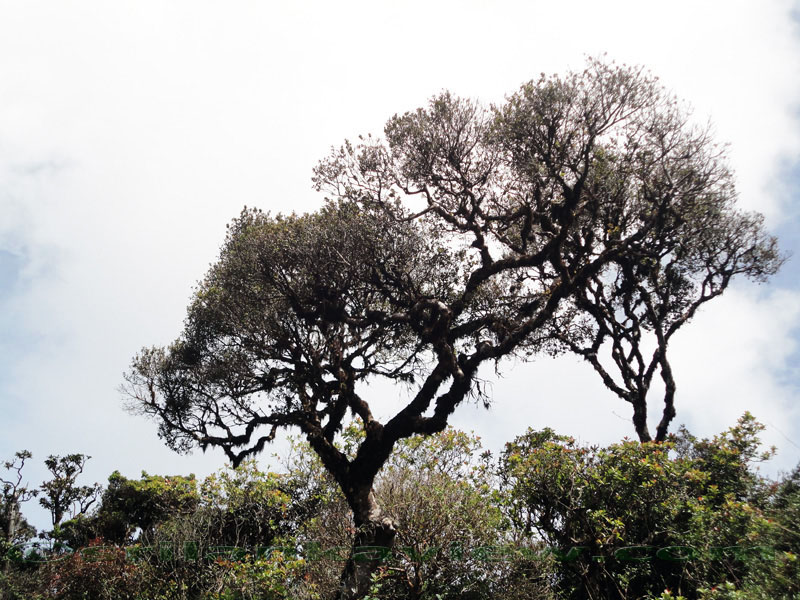
Pidurutalagala is located in the Central Highlands of Sri Lanka, a UNESCO World Heritage Site. The Central Highlands are renowned for their exceptional biodiversity and endemism, meaning that many of the plants and animals found here are unique to this region and are not found anywhere else in the world.
Some of the endemic species that can be seen in Pidurutalagala include the Sri Lankan leopard, the purple-faced langur, the Sri Lankan whistling thrush, and the Horton Plains slender loris.
History
Pidurutalagala has a rich and fascinating history that dates back to ancient times. According to local legend and folklore, Pidurutalagala is sometimes associated with stories from the Ramayana, including tales involving King Ravana. Pidurutalagala was also the site of a British observatory and a military base during the colonial era.
Today, Pidurutalagala hosts a radar station and a communication tower operated by the Sri Lankan Air Force. These facilities are off-limits to the Public, but you can still see them from a distance.
Can I climb Pidurutalagala?
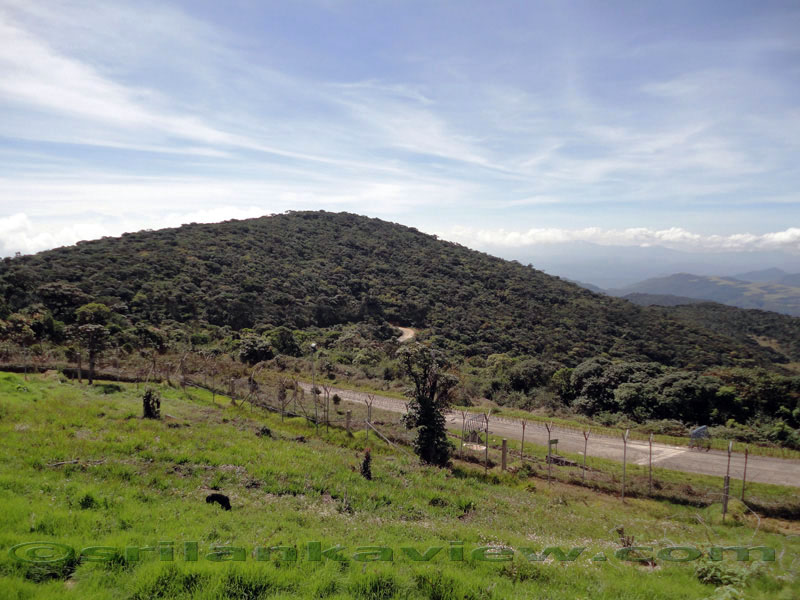
The mountain is closed to the general Public, as it is designated a high-security zone by the Sri Lankan army. Limited access may be granted during specific periods with prior authorization from the relevant authorities, subject to strict security protocols. Stopping, walking, or leaving the vehicle is strictly prohibited due to security regulations and the protected status of the mountain.
Where is the Pidurutalagala located?
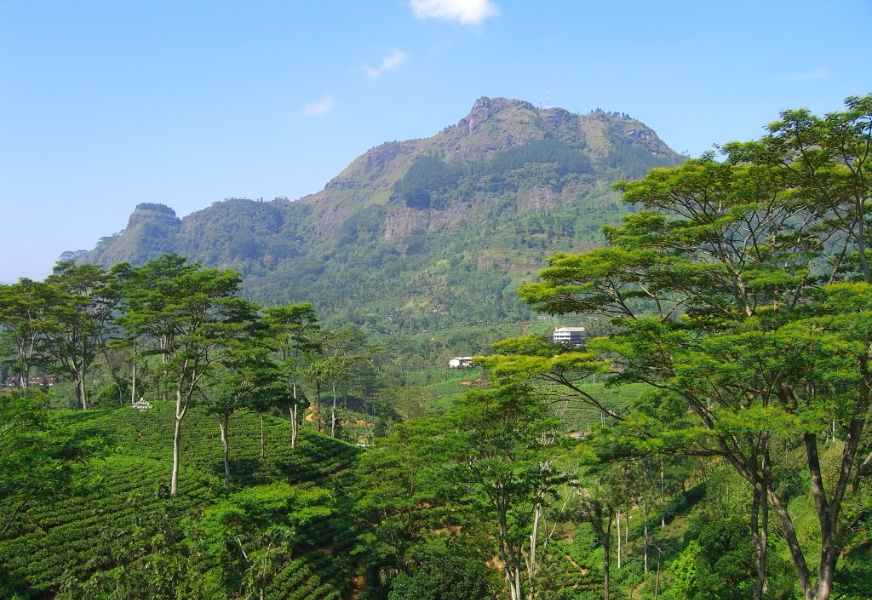
Pidurutalagala (Sinhala: පිදුරුතලාගල, pronounced [ˌpidurutaˈlaːɡələ], Straw Plateau Rock), or previously Mount Pedro in English, is the highest mountain in Sri Lanka, at 2,524 m (8,281 ft). It is situated North-North-East of the town of Nuwara Eliya and is easily visible from most areas of the Central Province.
How to reach Pidurutalagala?
Pidurutalagala is situated in the city of Nuwara Eliya, approximately 180 kilometers (112 miles) from Colombo, the capital of Sri Lanka. There are several ways to reach Pidurutalagala from different cities and regions in Sri Lanka by various modes of transport. Here are some of the options:
-
By Bus
The most affordable and common way to reach Pidurutalagala is by bus. You can take a bus from Colombo, Kandy, or any other major city to Nuwara Eliya, which takes about 5 to 6 hours.
-
By Train
The most scenic and comfortable way to reach Pidurutalagala is by train. You can take a train from Colombo, Kandy, or any other major city to Nanu Oya, which is the nearest railway station to Nuwara Eliya. The train ride takes approximately 6 to 8 hours and offers spectacular views of the countryside, mountains, and tea plantations.
From Nuwara Eliya, you can take another taxi or tuk-tuk to the Pidurutalagala entrance, which is about 10 kilometers (6 miles) away.
-
By Car
The fastest and most convenient way to reach Pidurutalagala is by car. You can rent a car from Colombo, Kandy, or any other major city and drive to Nuwara Eliya, which takes about 4 to 5 hours. From Nuwara Eliya, you can drive to the Pidurutalagala entrance, located approximately 10 kilometers (6 miles) away. The journey takes about 30 minutes.
Nearby Attractions
FAQ
1. Is Pidurutalagala open to the public?
Pidurutalagala is not open to the public year-round. Access is restricted because the summit is a high-security zone. Limited vehicle access may be allowed during specific periods with official authorization, but walking or hiking is not permitted.
2. Can you hike or trek Pidurutalagala?
No. Hiking and trekking are strictly prohibited. Visitors who receive permission are required to remain inside their vehicle at all times and follow security instructions throughout the visit.
3. Why is Pidurutalagala closed to visitors?
Pidurutalagala hosts critical national communication and monitoring infrastructure. To protect both security operations and the fragile high-altitude ecosystem, public access is tightly controlled.
4. How tall is Pidurutalagala?
Pidurutalagala is 2,524 meters (8,281 feet) above sea level, making it the highest mountain in Sri Lanka.
5. Can you see Adam’s Peak or the ocean from Pidurutalagala?
Visibility depends heavily on weather and cloud cover. While distant highland landmarks may be visible on exceptionally clear days, there are no guaranteed viewpoints, and stopping for viewing is not allowed during authorized visits.
6. Is Pidurutalagala part of Horton Plains?
No. Pidurutalagala is separate from Horton Plains National Park, although both are part of Sri Lanka’s Central Highlands. Horton Plains is open to visitors, while Pidurutalagala remains restricted.
7. Are there leopards or wildlife on Pidurutalagala?
The forest reserve supports wildlife, but visitors should not expect to see animals. Due to access restrictions and lack of public trails, wildlife encounters during visits are extremely rare.
8. Where is Pidurutalagala located?
Pidurutalagala is located just outside Nuwara Eliya, in Sri Lanka’s Central Province. The mountain is clearly visible from many parts of the town on clear days.
9. Why was Pidurutalagala called Mount Pedro?
During the British colonial period, the mountain was referred to as “Mount Pedro”, a simplified version of the Sinhala name, which was difficult for English speakers to pronounce.
10. Is Pidurutalagala worth visiting if you can’t climb it?
Pidurutalagala is worth visiting mainly for travelers interested in geography, highland ecosystems, or restricted places, rather than classic sightseeing. Those looking for hikes or viewpoints may find better experiences elsewhere in the region.
Videos
Location
If you’ve visited Pidurutalagala , feel free to share your experience in the comments below and inspire other travelers to discover this incredible destination.
By Tour My Lanka Editorial Team
– promoting sustainable and authentic travel across Sri Lanka.
Last Updated: January 2026
Images in this article are for illustration purposes and sourced from royalty-free platforms such as Pixabay and Unsplash.