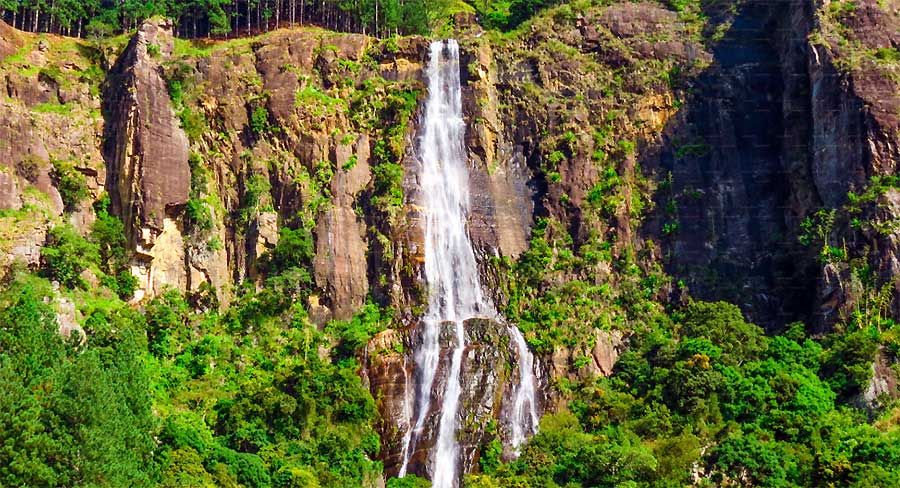

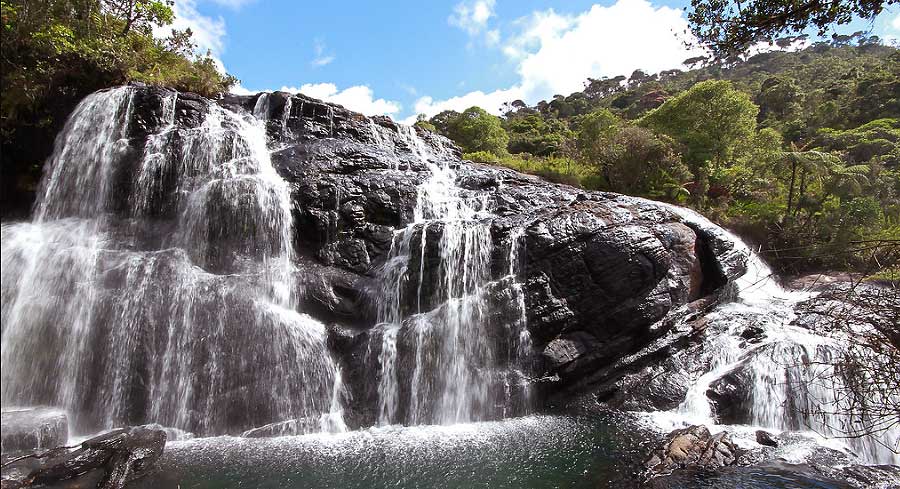
Located within the misty landscape of Horton Plains National Park, Baker’s Fall is one of the most quietly impressive waterfalls in Sri Lanka’s central highlands. Surrounded by montane forest and open grassland, the waterfall reflects the cool, high-altitude character of Sri Lanka’s central highlands.
Named after the 19th-century British explorer Sir Samuel Baker, who is believed to have discovered it in 1845, Baker’s Fall continues to enchant travelers, photographers, and nature enthusiasts alike. Rather than being a quick sightseeing stop, it’s a place that encourages visitors to slow down and observe the natural rhythm of the landscape.
What Makes Baker’s Fall Special
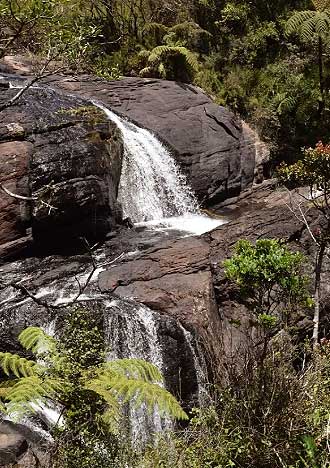
Baker’s Fall is formed by the Belihul Oya River, which flows gracefully through the plateau before plunging nearly 20 meters down a series of dark, rocky ledges. The black stone face of the cliff contrasts beautifully with the white foam of the water, while Rhododendron trees and giant ferns frame the scene in a lush green curtain.
Early in the morning, when mist still lingers across the plains, sunlight filters through the fog, giving the waterfall a dreamy, almost ethereal glow. The sound of water echoing through the valley mixes with the soft hum of forest life, making it one of the most peaceful spots in all of Horton Plains.
Wildlife sightings are common, too. Visitors occasionally spot sambar deer grazing, colorful birds like the Sri Lankan white-eye, or even the elusive purple-faced langur swinging through nearby trees. Every visit feels different — a new combination of light, mist, and life.
Quick Facts
- Location: Horton Plains National Park, Nuwara Eliya District
- Height: ~20 meters
- Formed by: Belihul Oya River
- Trail Length: 2.5 km (part of World’s End Loop)
- Best Time October: October to January (rainy season, stronger water flow)
- Opening Hours: 6:00 AM – 3:00 PM
- Entry Fee Approx: Varies by nationality and season (confirm at Horton Plains entrance)
A Glimpse Into History
The story of Baker’s Fall is intertwined with Sri Lanka’s colonial past. The waterfall is named after Sir Samuel Baker, a British explorer and naturalist who played a key role in exploring the country’s hill country during the mid-1800s.
Sir Baker documented the landscape extensively during his explorations of Sri Lanka’s hill country. His explorations helped map much of what we now know as Horton Plains, Nuwara Eliya, and the surrounding areas.
Today, the waterfall continues to bear his name — a reminder of the island’s early encounters between nature and exploration.
How to Get There
Baker’s Fall is located inside Horton Plains National Park, roughly 30 km from Nuwara Eliya and about 20 km from Ohiya.
From Nuwara Eliya:
- Hire a private car, taxi, or tuk-tuk to reach the park’s entrance.
- The drive takes around 1.5 hours and passes through tea estates and forested highland roads.
- Upon arrival, you’ll need to buy an entry ticket (prices vary for locals and foreigners) at the gate.
From Colombo or Kandy:
- Take a scenic train to Nanu Oya or Ohiya station.
- From there, continue by taxi or tuk-tuk to Horton Plains National Park.
- The drive from Colombo takes approximately 4–5 hours, while from Kandy, it’s about 3.5 hours.
Pro Tip: The final stretch to Horton Plains rises above 2,100 meters so that temperatures can drop sharply — pack a light jacket even on sunny days!
The Hike to Baker’s Fall
The waterfall is not accessible by road — you’ll need to hike to reach it. The trail is part of the famous World’s End Loop, a circular trek covering about 9.5 km through grasslands, cloud forests, and scenic viewpoints.
From the park entrance, the trail to Baker’s Fall is clearly marked. It takes roughly 45 minutes of moderate hiking through cool mist and lush vegetation. Along the way, you’ll cross small wooden bridges and patches of forest alive with birdsong. Due to the high elevation, the air feels noticeably cooler, and forest sounds are more pronounced than at lower altitudes.
The sound of flowing water becomes more noticeable as the trail descends toward the viewing platform. The final descent brings you to a wooden viewing platform, offering the perfect spot to admire the cascading water as it falls into a rocky gorge. On sunny mornings, light mist can occasionally create faint rainbow effects near the falls.
Best Time to Visit
Baker’s Fall can be visited year-round, though trail conditions and water flow vary by season:
- October to January (Rainy Season): The waterfall is at its most potent. Lush greenery and heavy mist make for spectacular photographs.
- February to May (Dry Season): Easier hiking conditions, clearer skies, and excellent visibility of the surrounding plains.
- June to September: Cooler, less crowded months — ideal for solitude and birdwatching.
The early morning hours (6 AM – 9 AM) are best for visiting, when mist adds a dreamy ambiance and wildlife is most active. Since Horton Plains closes by 3 PM, plan your entry early to enjoy both Baker’s Fall and World’s End within the same trek.
Things to See and Do Nearby
Horton Plains isn’t just about one waterfall — it’s an entire world of natural beauty waiting to be explored.
1. World’s End
Perhaps the park’s most famous feature, World’s End, is a dramatic 870-meter cliff drop offering sweeping views of the valleys and tea estates below. On clear days, you can even glimpse the distant southern coastline of Sri Lanka.
2. Mini World’s End
A smaller but equally breathtaking viewpoint that appears earlier on the same trail — great for photos if mist blocks the main World’s End view.
3. Chimney Pool
A calm, natural pool surrounded by forest, perfect for a short rest stop or quick photo break along the trail.
4. Nuwara Eliya Town
Known as “Little England” for its colonial architecture, gardens, and cool weather. Visit Gregory Lake, Hakgala Botanical Garden, and nearby tea factories to experience the island’s rich tea culture.
Photography & Travel Tips
- Golden Hour: Visit between 6 AM and 8 AM for soft lighting and misty backdrops.
- Gear: Bring a waterproof camera case or zip bag — spray from the falls can dampen your lens.
- Footwear: Sturdy trekking shoes with grip are essential.
- Clothing: Wear layers — mornings are cold, but afternoons warm up.
- Avoid littering: Carry all waste out of the park.
- Respect nature: Don’t disturb wildlife or climb rocks near the falls.
For the best photos, stand slightly off-center on the viewing platform — this captures both the waterfall and its surrounding ferns in one frame.
What Most Visitors Don’t Notice at Baker’s Fall
Many travelers spend only a few minutes at Baker’s Fall before moving on toward World’s End – but those who linger notice something subtle and special. Unlike the dramatic cliff views elsewhere in Horton Plains, Baker’s Fall has a rhythm. The water doesn’t crash violently; it slides, splits, and reforms over dark rock in a steady, almost hypnotic flow.
On calm mornings, the soundscape changes every few minutes – birds calling from the tree line, wind brushing the grasslands above, then silence broken only by water. Local hikers often pause here longer than expected, not for photos, but simply to rest and listen. It’s one of the few places on the trail where Horton Plains feels intimate rather than vast.
If you arrive when mist drifts upward from the gorge, the waterfall appears and disappears in layers – never fully revealing itself at once. This fleeting visibility is what makes Baker’s Fall memorable, even without dramatic height or volume.
The Mist Factor: Why Timing Matters More Than Weather
Many visitors assume clear skies guarantee the best view of Baker’s Fall. In reality, mist timing matters more than sunshine. Between 6:30 AM and 8:30 AM, rising mist from the gorge often creates a soft veil that enhances depth and texture – ideal for photography and atmosphere.
After mid-morning, mist usually lifts quickly, exposing the rock face fully. While this gives clarity, it removes the layered effect that makes the waterfall feel alive. By late morning, the area can feel noticeably busier and quieter at the same time – more footsteps, fewer natural sounds.
Experienced Horton Plains hikers plan Baker’s Fall before World’s End, not after. By the time many trekkers loop back, light is harsher and mist has vanished, making the waterfall visually flatter.
Common First-Time Mistakes at Baker’s Fall
- Rushing the stop – Many visitors treat Baker’s Fall as a quick checkpoint instead of a rest point. Sitting quietly for 10 minutes reveals wildlife movement and shifting light most people miss.
- Wearing smooth-soled shoes – The viewing area may look safe, but damp wooden steps and mist-covered stone can be slippery.
- Entering the park too late – Arriving after 8:30 AM often means mist loss and heavier foot traffic.
- Expecting swimming access – This is a protected waterfall, not a recreational pool. Planning otherwise leads to disappointment.
- Ignoring altitude effects – Even light walking can feel tiring at over 2,100 meters, especially for visitors arriving straight from Colombo.
Who Baker’s Fall May Not Be Ideal For
Baker’s Fall is not designed for adrenaline seekers or travelers looking for dramatic cliff-side selfies. If your priority is swimming, rock climbing, or high-volume waterfalls like Bambarakanda or Diyaluma, this spot may feel understated.
It’s also not ideal for visitors with limited walking ability, as access requires a moderate hike with uneven terrain. Baker’s Fall rewards patience and observation more than spectacle — something worth knowing before planning your visit.
Local Insight: Why Guides Quietly Respect This Spot
Local guides often lower their voices near Baker’s Fall – not due to rules, but habit. Among regular Horton Plains trekkers, this area is seen as a natural pause point, a place to slow the group before the more exposed sections of the trail.
During dry months, guides sometimes point out how water flow reveals older rock layers beneath the falls – a subtle reminder that this landscape is constantly changing. Unlike World’s End, which impresses instantly, Baker’s Fall earns respect gradually.
Conservation and Responsible Tourism
Horton Plains is a UNESCO World Heritage Site and one of Sri Lanka’s most fragile ecosystems. The plateau is home to unique species such as the purple-faced langur, Sri Lankan sambar, and several endemic bird species.
- To help preserve this environment:
- Avoid plastic bottles or single-use items.
- Stick to marked trails to protect native flora.
- Do not feed animals or leave food scraps.
- Support eco-friendly lodges and local guides who practice sustainable tourism.
Visitor behavior plays a direct role in preserving Horton Plains’ fragile high-altitude ecosystem.
FAQs
1. Is Baker’s Fall worth visiting if I’m already going to World’s End?
Yes. Baker’s Fall offers a completely different experience from World’s End. While World’s End is about dramatic views and wide-open landscapes, Baker’s Fall feels quieter and more immersive. Many visitors find it more relaxing, especially in the early morning when mist and forest sounds create a calm atmosphere that World’s End lacks.
2. How long does it take to walk to Baker’s Fall inside Horton Plains?
From the main Horton Plains entrance, it takes about 40–50 minutes of moderate walking to reach Baker’s Fall. The trail is well-marked and mostly flat, with gentle descents near the viewing platform. Most visitors reach the waterfall before World’s End if they start the loop early.
3. Do you see wildlife near Baker’s Fall?
Wildlife sightings near Baker’s Fall are possible, especially early in the morning. Sambar deer are sometimes seen grazing near the tree line, and birdwatchers often spot endemic species such as the Sri Lankan white-eye. Monkeys are less common here compared to other parts of the park, making the area feel relatively peaceful.
4. Is Baker’s Fall safe to visit during the rainy season?
Baker’s Fall can be visited during the rainy season, but extra caution is needed. The trail can become slippery, especially near wooden steps and damp rock surfaces. While the waterfall is more powerful after rain, visibility may be reduced due to mist, and sturdy footwear is essential.
5. Can you go close to the water at Baker’s Fall?
No. Visitors are restricted to a designated viewing platform. This is for safety and conservation reasons, as the rocks around the waterfall are extremely slippery and the area is ecologically sensitive. Swimming or climbing near the falls is strictly prohibited.
6. What is the best time of day to see Baker’s Fall clearly?
The best time to see Baker’s Fall is early morning, between 6:00 AM and 8:30 AM. During this period, mist often enhances the atmosphere without completely blocking the view, and there are fewer visitors. Later in the day, the waterfall is still visible, but the lighting is harsher and the area tends to be busier.
7. Is Baker’s Fall suitable for children or elderly visitors?
Baker’s Fall is suitable for older children who are comfortable walking moderate distances. However, it may be challenging for elderly visitors or those with mobility issues due to uneven paths, cool temperatures, and the overall length of the Horton Plains loop.
8. Do I need a guide to visit Baker’s Fall?
A guide is not required, as the trail is clearly marked and well-maintained. However, hiring a guide can enhance the experience by helping you spot wildlife, understand the ecosystem, and manage timing — especially if you plan to cover World’s End and Baker’s Fall in one hike.
9. How much time should I spend at Baker’s Fall?
Most travelers spend 10–20 minutes at Baker’s Fall. Visitors who arrive early often stay longer, using the area as a rest point to enjoy the sounds of the waterfall and surrounding forest before continuing the hike.
10. Is Baker’s Fall crowded compared to other places in Horton Plains?
Baker’s Fall is usually less crowded than World’s End, especially in the early morning. Most crowds gather at the cliff viewpoints, so visitors who time their hike well often experience Baker’s Fall in a quieter, more relaxed setting.
Why Baker’s Fall Should Be on Your Sri Lanka Itinerary
Baker’s Fall is more than a scenic stop — it’s a journey through mist, wilderness, and history. The path that leads to it reminds you to slow down, listen to nature’s rhythm, and appreciate the beauty of stillness.
Whether you’re capturing photos, hiking through cloud forests, or simply standing still to breathe in the cool mountain air, Baker’s Fall offers an unforgettable escape into Sri Lanka’s pristine highlands.
It’s a place best appreciated without rushing — where quiet observation often leaves a stronger impression than dramatic scenery.
If you’ve visited Baker’s Fall, please share your experience in the comments below!
By Tour My Lanka Editorial Team
– promoting sustainable and authentic travel across Sri Lanka.
Last Updated: January 2026
Images in this article are for illustration purposes and sourced from royalty-free platforms such as Pixabay and Unsplash.
Disclaimer: Ticket prices, opening hours, and transportation costs mentioned in this article may change due to seasonal or administrative updates. Please confirm with the relevant local authorities before visiting.