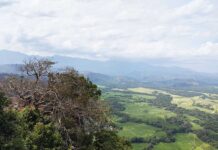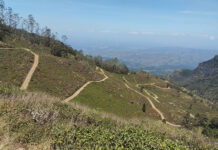

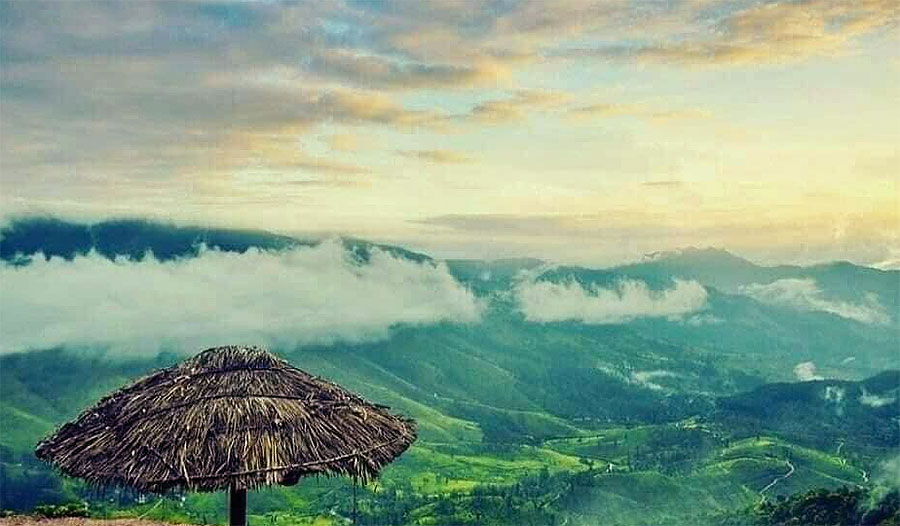
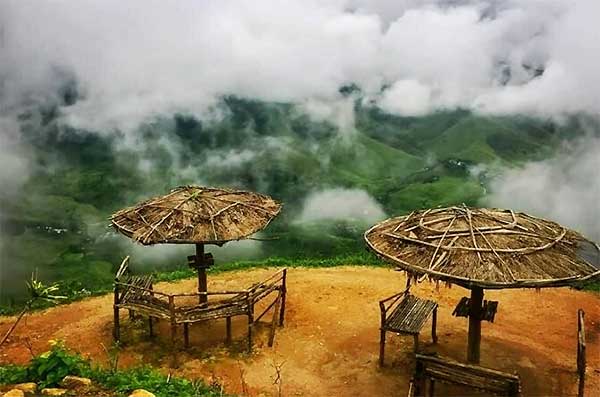
Kelebokka (කැලෑබොක්ක) is a high-elevation viewpoint within a working tea estate in the Matale District, known less for facilities and more for its uninterrupted hill-country panorama and raw, windswept setting. The viewpoint sits at the highest accessible point of the Kelebokka Tea Estate, one of the largest contiguous tea estates managed by the Sri Lanka State Plantation Corporation.
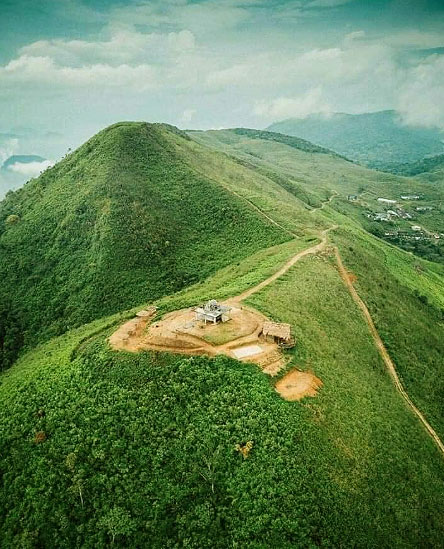
A Camping site and two estate bungalows are available for visitors to stay, but need to be booked in advance. There is a half-finished Hindu shrine at the center of the flat summit and a hut made using sticks to enjoy the vistas. It’s best to visit in the mornings to enjoy the unobstructed views, as mist often covers the area in the afternoons.
Top Reasons to Visit Kelebokka 360 Viewpoint
- Open 360-degree views with no built structures interrupting the landscape – Experience breathtaking vistas of Matale’s majestic mountains, lush tea plantations, and distant towns.
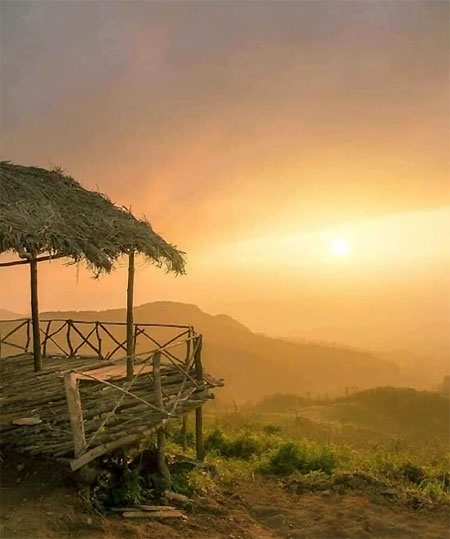
- Best experienced during early morning and late evening light conditions – The golden hues over the hills create a magical atmosphere.
- Great for Photography and Drone Shots– Capture stunning landscapes and long-exposure shots of winding roads.
- Less frequented compared to major hill-country viewpoints due to limited access – Less crowded than other viewpoints, offering a serene experience.
- Cool climate and lush tea estate surroundings
What Most Visitors Miss at Kelebokka
What many first-time visitors don’t realize is that Kelebokka isn’t just a “viewpoint” — it’s a working landscape. The tea pluckers you see in the early morning aren’t there for show; this is a living estate where daily routines continue regardless of visitors.
If you arrive before 7:00 AM, you’ll often hear estate workers chatting in the distance, kettles boiling in small line-room houses below, and the soft metallic sound of tea baskets being adjusted. This quiet human presence adds depth to the scenery – reminding you that Kelebokka is not a theme-park hilltop, but part of Sri Lanka’s real highland life.
Taking a few minutes to observe this rhythm — rather than rushing to photograph everything — makes the experience far more meaningful.
Location of Kelebokka Viewpoint
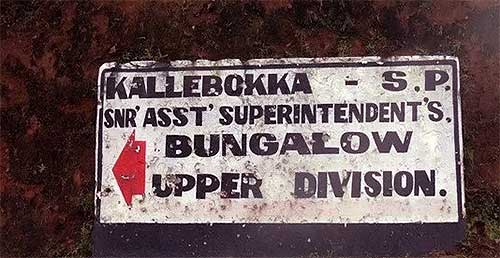
The site is located 35 km from Kandy and 25 km from Matale. Traveling from Kandy, you need to take the picturesque Madawala–Bambarella road, which winds through the mountains, and then take the Kabaragala Road after 25 km. After about 10 km on this road, you need to turn into the estate and the by-road leading to the senior assistant superintendent’s bungalow on the upper division of Kelebokka.
The turning point to the peak is located in a small village called Kandenuwara. A clearly marked estate signboard indicates the turn toward the upper division of the Kelebokka estate.
Weather at Kelebokka
- Consistent wind exposure throughout the year due to the open summit location
- Avg. summit temp: 14–18°C in mornings
- By late morning or early afternoon, fast-moving clouds often roll in, frequently reducing visibility within minutes
If your goal is photography → aim for clear skies: Jan–Sep
Best weather: January – September.
Location Map
How to go Kelebokka
- From Kandy to Kalebokka: From Kandy, take the scenic Madawala – Bambarella route toward Kabaragala. From Kandenuwara village, follow the signboard leading into the upper division of the Kelebokka Tea Estate. The final 3 km stretch is a rough estate road.
- From Matale to Kelebokka: Drive down the Kandy road about 1.5 km and turn left onto Kabaragala Road. Madulkelle -> Kabaragala -> Kandenuwara
- By Bus: Get to Wattegama and take the Kabaragala bus, which will take you to the turning point.
Estimated Travel Time
🚗 From Kandy: ~1 hr 20 min
🚗 From Matale: ~50 min
Opening Hours Kelebokka
General visiting hours are typically between 6:00 AM and 6:00 PM. Access may be restricted on certain days depending on estate operations.
Best Time to Visit
- Early Morning (5:30 AM – 7:00 AM): Ideal for capturing the sunrise and enjoying clear views.
- Late Afternoon (4:00 PM – 6:00 PM): Ideal for enjoying the sunset and cooler temperatures.
- Avoid Rainy Season (October – December): Fog may obstruct views.
A Photographer’s Timing Trick
A small timing detail most blogs don’t mention: the clearest light at Kelebokka usually comes 15–25 minutes after sunrise, not at sunrise itself.
At dawn, mist often sits low in the valleys. As the sun rises slightly higher, the mist begins to lift — revealing layered mountain ridges, winding estate roads, and distant valleys all at once. This brief window offers more depth and contrast than the golden-hour glow alone.
If you’re shooting with a phone, this is when HDR works best. If you’re using a camera, a moderate aperture (f/8–f/11) helps keep the layers sharp without overexposing the sky.
The “Silence Moment” That Makes Kelebokka Special
There’s a short, almost unnoticed moment at Kelebokka that defines the visit for many travelers: the pause between wind gusts.
When the breeze stops — even briefly — the estate falls completely silent. No traffic noise, no vendors, no crowd chatter. Just open air and distant hills. This silence is rare in Sri Lanka, especially so close to major towns like Kandy and Matale.
Standing still during this moment, rather than talking or filming, often becomes the most memorable part of the visit — something photos can’t capture.
Common First-Time Mistakes at Kelebokka
- Arriving too late in the morning and missing clear views
- Assuming mobile signal will be reliable (it’s not)
- Wearing sandals instead of proper shoes on wet estate paths
- Standing too close to cliff edges for photos
- Underestimating how quickly weather can change
Planning for these small details often makes the difference between a rushed stop and a genuinely rewarding visit.
Safety Tips for Visiting Kelebokka
- The final road stretch is steep and rugged – 4×4 or tuk-tuk recommended
- There are no permanent safety barriers near cliff edges, so close supervision is necessary, especially with children.
- Expect leeches during rainy months – carry repellent/salt
- Weather changes quickly – bring jackets & extra water
- Avoid visiting during thunderstorms due to lightning risk
How much is the ticket for Kelebokka?
Visitors are generally required to pay a small entry fee collected by estate staff to support site maintenance. Fees may vary and are subject to change.
Reservations at Kellebokka Camping Site and Bungalows
For camping and bungalow reservations, visitors must book in advance through the Sri Lanka State Plantation Corporation. Availability and pricing may vary based on season and group size.
Realistic Camping Expectations
Set realistic expectations before camping at Kelebokka.
This is not a luxury campsite. Nights can be extremely cold, winds can be strong, and facilities are basic. On clear nights, temperatures often feel colder than nearby towns due to constant airflow at the summit.
However, this simplicity is exactly why seasoned local campers love Kelebokka. Cooking a simple meal while clouds drift below you, watching stars with no light pollution, and waking up to tea estate views at dawn offers an experience far richer than comfort-based stays.
If you value quiet, raw nature, and self-sufficiency — Kelebokka delivers. If you expect convenience, it may not.
Kelebokka to Sembuwatta Lake
There is a foot pathway from Kelebokka to Sembuwatta. The journey takes approximately 20-30 minutes. Please note that a ticket must be purchased at the entrance of Sembuwatta. Then you have to walk down another 700 m and come back.
You can reach Sembuwatta Lake from Elkaduwa (Elkaduwa is accessible from either Kandy or Matale). The road condition is good till the ticket counter / Sembuwatta tea factory. There are three-wheelers from the Tea factory to Sembuwatta Lake. You are not allowed to get into the lake. There is a swimming pool for bathing. Alcohols are not permitted within the lake premises.
Nearby Attractions to Combine with Kelebokka
1. Sembuwatta Lake
It is surrounded by pine forests and rolling tea estates, this man-made lake, fed by natural spring water, offers a refreshing escape from the heat and hustle of city life. Whether you’re looking to relax by the calm waters, take a peaceful walk through forest trails, or enjoy a bit of adventure with activities like zip-lining and paddle boating.
2. Riverston
Riverston is renowned among nature lovers and adventure seekers, both locally and internationally. Located near Matale, this high-altitude escape is known for its breathtaking views, cool climate, and mist-shrouded landscapes that feel almost otherworldly.
3. Pitawala Pathana (Mini World’s End) – 25 min from Kelebokka
Pitawala Pathana, often referred to as the Mini World’s End, offers one of Sri Lanka’s most awe-inspiring viewpoints. Located in the Matale District, this vast grassland plateau unfolds like a green carpet across the highlands, ending abruptly at a dramatic 1,200-meter drop.
4. Knuckles Mountain Range
Knuckles Mountain Range, named for its resemblance to a clenched fist, offers an extraordinary escape into the island’s most rugged and biodiverse landscapes. Located in the Matale District and part of a UNESCO World Heritage Site, this mountain wilderness is a haven for trekkers, bird watchers, and nature enthusiasts.
5. Hunnas Falls
A 48-meter-high waterfall located near Elkaduwa, offering picturesque views and a serene environment.
6. Sera Ella
A unique waterfall is split into two segments, with a hidden cave located behind the cascading water, accessible via a set of steps.
7. Aluvihare Rock Temple – 01 hour drive
Aluvihare Rock Temple is a sacred site steeped in history and cultural significance. Believed to be the place where the Pāli Canon—the earliest scriptures of Theravāda Buddhism—was first written down, this ancient temple complex dates back to the 3rd century BCE. Visitors can explore its peaceful cave shrines, centuries-old frescoes, and stone-carved inscriptions that tell stories of devotion, resilience, and scholarship.
8. Sri Muthumariamman Temple
A vibrant Hindu temple in Matale, renowned for its Dravidian architecture and annual chariot festival.
9. Mahatma Gandhi Memorial Centre
A center commemorating Mahatma Gandhi’s 1927 visit to Sri Lanka, promoting peace and nonviolence.
10. Christ Church, Matale
An Anglican church consecrated in 1860, showcasing Neo-Gothic architecture and historical significance.
11. Matale Spice Gardens – 1.5-hour drive
Discover Sri Lanka’s renowned spices, including cinnamon, cardamom, and pepper.
Who Kelebokka Is Not Ideal For
Kelebokka may not be ideal if you:
- Prefer locations with cafés, shops, or restrooms
- Are uncomfortable with rough access roads
- Expect guarded viewpoints or safety railings
- Are sensitive to cold or strong wind
Understanding this beforehand helps ensure the visit matches your travel style — and avoids disappointment.
FAQ
1. Is Kelebokka 360 Viewpoint crowded like other hill-country viewpoints?
No. Kelebokka usually remains quiet because it sits inside a working tea estate and requires travel on a rough access road. Even on weekends, visitor numbers are generally low compared to popular viewpoints near Kandy or Nuwara Eliya.
2. Can you reach Kelebokka 360 Viewpoint with a normal car?
A normal car can reach the estate turning point, but the final 3 km stretch is uneven and steep. Three-wheelers, 4WD vehicles, or walking the last section are safer options, especially after rain.
3. What time should I arrive to avoid mist at Kelebokka?
The clearest conditions are typically between 5:45 AM and 7:30 AM. Mist often forms rapidly after mid-morning due to changing wind patterns and cloud movement at the summit.
4. Is Kelebokka suitable for elderly visitors?
It can be, provided they are comfortable with cold wind, uneven ground, and limited seating. The viewpoint itself does not require a long hike, but access roads and exposed edges require caution.
5. How cold does it actually get at Kelebokka?
Early mornings can feel significantly colder than nearby towns, especially when wind is strong. While temperatures may range between 14–18°C, wind chill can make it feel colder at the open summit.
6. Is it safe to fly a drone at Kelebokka?
Drone flying is commonly done by visitors due to the open space, but there are no official drone facilities or designated zones. Visitors should be mindful of estate workers, changing winds, and current local regulations before flying.
7. Are there food stalls or toilets at the viewpoint?
No. Kelebokka has no permanent facilities. Visitors should bring water, snacks, and take all waste back with them.
8. Can Kelebokka be visited together with Sembuwatta Lake in one trip?
Yes. Many travelers combine an early-morning visit to Kelebokka with a late-morning visit to Sembuwatta Lake. However, Sembuwatta has separate entry requirements and operates under different management.
9. Is camping at Kelebokka suitable for beginners?
Camping is possible but best suited for those with prior outdoor experience. Wind exposure, cold nights, and basic facilities mean visitors should be fully self-prepared rather than expecting managed campsite services.
10. Does mobile network coverage work at Kelebokka?
Mobile signal is unreliable and varies by network. Data connectivity can drop completely at the summit, so offline maps and prior coordination are recommended.
11. Do you need permission to visit Kelebokka 360 Viewpoint?
Day visits generally require a small entry fee collected by estate staff. Camping and bungalow stays must be arranged in advance through the relevant estate authorities.
Videos
Final Thoughts
Kelebokka 360 Viewpoint is one of those places that remind you how beautiful Sri Lanka truly is – wide-open landscapes, refreshing air, and pure relaxation. Whether you’re here for sunrise magic, tea-country adventure, or a weekend camping escape… this is a view worth waking up early for!
If you’ve visited Kelebokka 360 Viewpoint, please share your experience in the comments below!
By Tour My Lanka Editorial Team
– promoting sustainable and authentic travel across Sri Lanka.
Last Updated: January 2025
This guide is based on firsthand exploration of Kelebokka 360 Viewpoint and verified local travel routes. Details reflect real visitor conditions, not promotional descriptions, and are updated to help travelers plan responsibly and realistically.
Images in this article are for illustration purposes and sourced from royalty-free platforms such as Pixabay and Unsplash.
Disclaimer: Ticket prices, opening hours, and transportation costs mentioned in this article may change due to seasonal or administrative updates. Please confirm with the relevant local authorities before visiting.